The rise of on-demand services has made the hyperlocal delivery platform a core business model for industries like food delivery, grocery, pharmacy, and quick commerce. But behind the smooth user experience lies a complex system of interconnected applications working in real time.
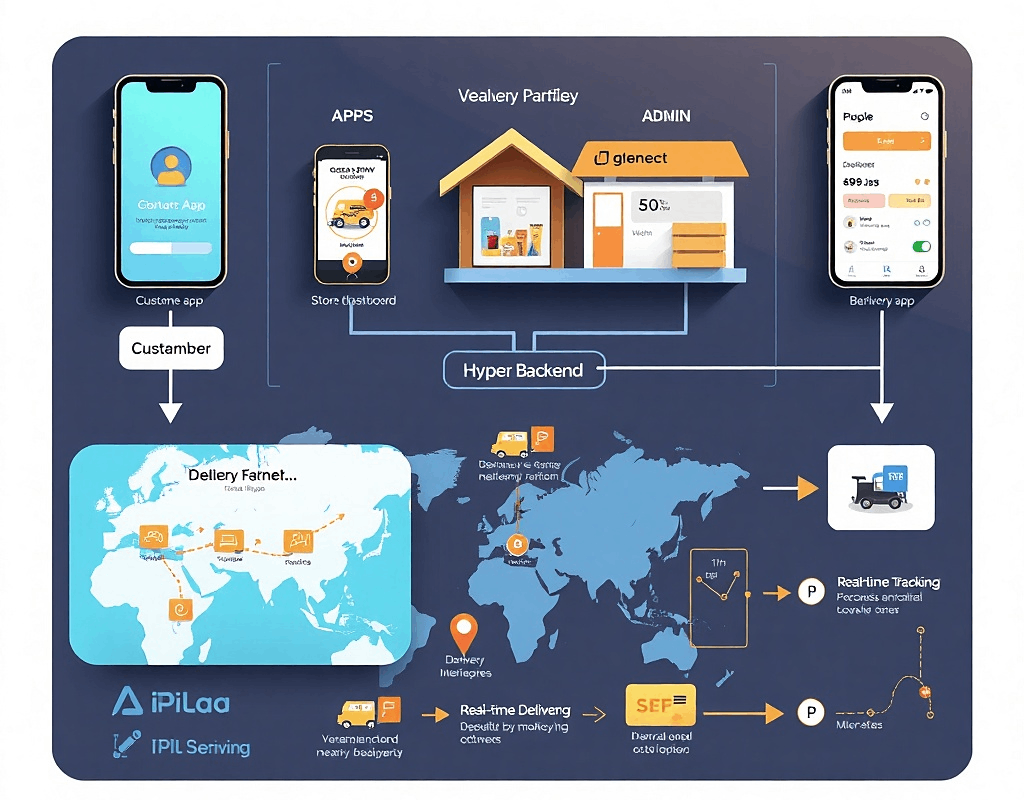
In this blog, we’ll break down the architecture of a hyperlocal delivery platform in a practical, easy-to-understand way—covering the four key components: customer app, delivery app, merchant dashboard, and admin system.
What is a Hyperlocal Delivery Platform?
A hyperlocal delivery platform connects customers with nearby merchants and delivery partners to fulfill orders within a short geographic radius—often within minutes or hours.
Think of it as a real-time ecosystem where:
- Customers place orders
- Merchants prepare them
- Delivery partners fulfill them
- The system orchestrates everything seamlessly
High-Level Architecture Overview
At a high level, a hyperlocal delivery platform consists of:
- Frontend Applications
- Customer App (Mobile/Web)
- Delivery Partner App
- Merchant Dashboard
- Admin Panel
- Customer App (Mobile/Web)
- Backend System
- APIs and business logic
- Order management system
- Payment processing
- Real-time tracking
- APIs and business logic
- Infrastructure
- Cloud hosting (AWS, Azure, GCP)
- Databases (SQL/NoSQL)
- Notification services
- Map & location services
- Cloud hosting (AWS, Azure, GCP)
Let’s break down each component.
1. Customer App (User-Facing Interface)
This is where the journey begins.
Key Features:
- User registration & login
- Location detection (GPS-based)
- Browse nearby stores/products
- Add to cart & checkout
- Payment integration (UPI, cards, wallets)
- Real-time order tracking
- Push notifications
Architecture Considerations:
- Frontend: Built using Flutter, React Native, or native Android/iOS
- Backend APIs: Fetch merchant listings, pricing, availability
- Maps Integration: For location detection and tracking
- Real-time updates: WebSockets or Firebase for live order status
👉 The goal: fast, intuitive, and frictionless ordering experience
2. Delivery Partner App
This app powers the logistics engine of the platform.
Key Features:
- Login & profile verification
- Order request notifications
- Accept/reject orders
- Navigation & route optimization
- Earnings dashboard
- Availability toggle (online/offline)
Architecture Considerations:
- Real-time communication: Critical for order assignment
- GPS tracking: Continuous location updates
- Battery optimization: Efficient tracking without draining device
- Push notifications: Instant order alerts
👉 The goal: efficient order fulfillment with minimal delays
3. Merchant Dashboard (Vendor Panel)
Merchants use this interface to manage their business operations.
Key Features:
- Product/menu management
- Order notifications
- Order status updates (accepted, preparing, ready)
- Inventory management
- Pricing & offers
- Sales analytics
Architecture Considerations:
- Web-based dashboard: Typically built using React or Angular
- Inventory sync: Real-time stock updates
- Order management APIs: Centralized system
- Scalability: Handle multiple merchants simultaneously
👉 The goal: empower merchants to operate efficiently and respond quickly
4. Admin System (Control Center)
The admin panel is the brain of the entire hyperlocal delivery platform.
Key Features:
- User, merchant, and delivery partner management
- Order monitoring & dispute resolution
- Commission & pricing configuration
- Analytics & reporting
- Promotions and campaigns
- System configuration
Architecture Considerations:
- Role-based access control (RBAC)
- Data dashboards: Insights into operations
- Fraud detection & monitoring tools
- Scalable backend services
👉 The goal: full visibility and control over platform operations
Backend Architecture: The Core Engine
All four components connect to a centralized backend system.
Key Backend Modules:
- User Service – authentication & profiles
- Order Management System (OMS) – handles order lifecycle
- Payment Gateway Integration – secure transactions
- Delivery Allocation Engine – assigns orders intelligently
- Notification Service – SMS, email, push alerts
- Location Service – geolocation and routing
Tech Stack Example:
- Backend: Node.js / Java / Python
- Database: PostgreSQL + MongoDB
- Caching: Redis
- Messaging: Kafka / RabbitMQ
- Cloud: AWS / GCP
Real-Time Features: The Differentiator
A successful hyperlocal delivery platform relies heavily on real-time capabilities:
- Live order tracking
- Instant delivery partner assignment
- Dynamic ETA updates
- Real-time inventory sync
Technologies used:
- WebSockets
- Firebase Realtime Database
- Pub/Sub systems
Scalability & Performance
As the platform grows, scalability becomes critical.
Key Strategies:
- Microservices architecture
- Load balancing
- Auto-scaling infrastructure
- CDN for faster content delivery
- Database sharding
Security & Compliance
Handling payments and user data requires strong security:
- End-to-end encryption (HTTPS)
- Secure payment gateways
- Data privacy compliance
- Role-based access control
- Regular audits
Final Thoughts
Building a hyperlocal delivery platform is not just about creating apps—it’s about designing a tightly integrated system that operates in real time across multiple stakeholders.
Success depends on:
- Strong backend architecture
- Seamless user experience
- Efficient logistics coordination
- Scalable infrastructure
Thinking of Launching a Platform Like This?
If you’re exploring the idea of building a hyperlocal delivery platform, having the right technology partner can make all the difference. Turnkey Infotech works with startups and businesses to design and develop digital products that are scalable, user-friendly, and built for real-world operations.
From architecture planning to full product development, the right approach ensures your platform performs smoothly as it grows.
What can be built:
- Websites
- Ecommerce platforms
- Mobile apps
- SaaS platforms
- Marketplace solutions
- Custom software
Whether you’re validating an idea or ready to launch, it’s worth discussing how your platform can be structured and brought to life effectively.
👉 Book a Free Consultation or Request a Free Demo to explore your idea and see how a platform like this could be built.