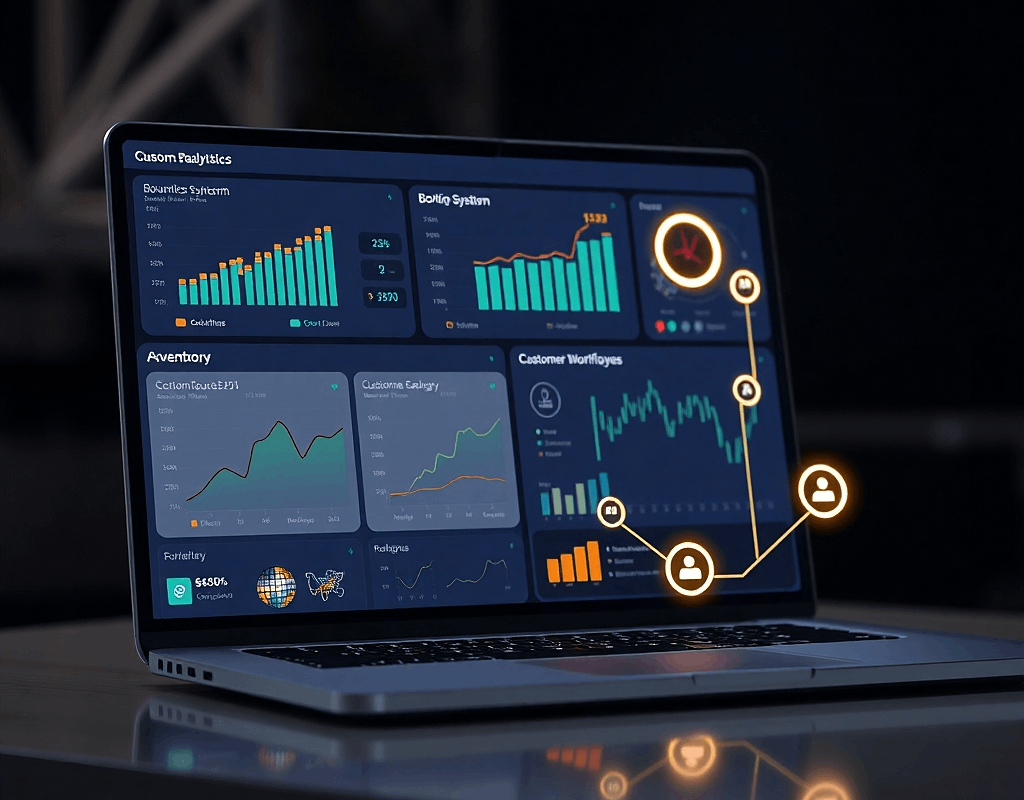
In today’s fast-moving digital economy, businesses are expected to operate faster, smarter, and more efficiently than ever before. Yet many companies still rely on disconnected tools, manual spreadsheets, and repetitive processes to manage critical operations such as sales tracking, bookings, inventory, and customer communication.
This is where custom software platforms play a transformative role.
A well-designed digital platform can bring multiple business functions into a single, unified system, allowing teams to automate workflows, reduce errors, improve customer experience, and make data-driven decisions in real time.
Let’s explore how custom platforms help automate key business functions and unlock operational efficiency.
1. Automating Sales Management
Sales teams often spend a large portion of their time managing leads, updating spreadsheets, tracking follow-ups, and preparing reports.
A custom sales management platform can automate these tasks and provide a centralized dashboard for the entire sales process.
Key features may include:
- Lead capture and tracking
- Automated follow-up reminders
- Sales pipeline visualization
- Proposal and quotation generation
- Sales analytics and reporting
By automating these processes, businesses can ensure that no leads are lost, follow-ups happen on time, and sales teams focus more on closing deals rather than managing data.
2. Streamlining Business Operations
Operational workflows are the backbone of any organization. However, manual processes often slow down productivity and increase the risk of errors.
Custom software platforms can automate operational tasks such as:
- Task assignment and tracking
- Internal approvals and workflows
- Document management
- Team collaboration
- Performance monitoring
When operations are digitized, teams gain greater transparency and accountability, while managers can easily monitor progress and identify bottlenecks.
3. Managing Bookings and Appointments
Businesses in industries like hospitality, healthcare, consulting, and services depend heavily on booking and scheduling systems.
A custom booking platform can automate the entire scheduling process.
Typical capabilities include:
- Online appointment scheduling
- Real-time availability management
- Automated confirmations and reminders
- Rescheduling and cancellation management
- Integration with calendars and payment gateways
This reduces administrative workload and ensures a smooth booking experience for customers.
4. Smart Inventory Management
Inventory mismanagement can lead to lost sales, overstocking, or supply chain disruptions.
Custom inventory platforms help businesses maintain accurate, real-time visibility of stock levels.
Features often include:
- Automated stock tracking
- Low inventory alerts
- Purchase order management
- Supplier management
- Multi-location inventory tracking
With automation, businesses can optimize stock levels, reduce wastage, and improve procurement planning.
5. Centralized Customer Management
Customer relationships are one of the most valuable assets a business has. However, when customer data is scattered across emails, spreadsheets, and different tools, it becomes difficult to maintain strong engagement.
A custom Customer Management Platform (CRM) centralizes all customer information and interactions.
Key benefits include:
- Unified customer profiles
- Communication history tracking
- Automated marketing campaigns
- Support ticket management
- Customer analytics and segmentation
This enables businesses to deliver personalized experiences, faster support, and stronger long-term relationships.
6. Real-Time Data and Business Insights
Perhaps one of the biggest advantages of a unified platform is data visibility.
When sales, operations, bookings, inventory, and customer management are integrated, business leaders gain access to powerful insights such as:
- Sales performance trends
- Customer behavior patterns
- Operational efficiency metrics
- Inventory forecasting
- Revenue analytics
This allows organizations to make smarter decisions faster and continuously improve their strategy.
7. Scalability for Growing Businesses
As businesses grow, their operational complexity increases. Manual systems that worked in the early stages often become unsustainable.
Custom software platforms are built with scalability in mind, allowing companies to:
- Add new modules
- Integrate third-party tools
- Expand to new markets
- Support larger teams and customer bases
Instead of constantly switching tools, businesses can evolve their platform as their operations grow.
Thinking of Launching a Platform Like This?
If you’ve ever thought about building a platform that automates operations like sales, bookings, inventory, or customer management, you’re not alone. Many startups and businesses are exploring digital platforms to streamline operations and create new revenue opportunities.
At Turnkey Infotech, we help startups, entrepreneurs, and businesses design and develop powerful digital products built on the right technology architecture.
Our team builds solutions such as:
- Websites
- Ecommerce platforms
- Mobile apps
- SaaS platforms
- Marketplace platforms
- Custom business software
Building a platform like this requires thoughtful planning, scalable architecture, and the right development expertise to ensure it grows with your business.
If you have an idea or want to explore how a platform like this could work for your business, we’d love to help.
Request a Free Demo or Book a Free Consultation to discuss your idea and see how your digital platform could come to life. 🚀